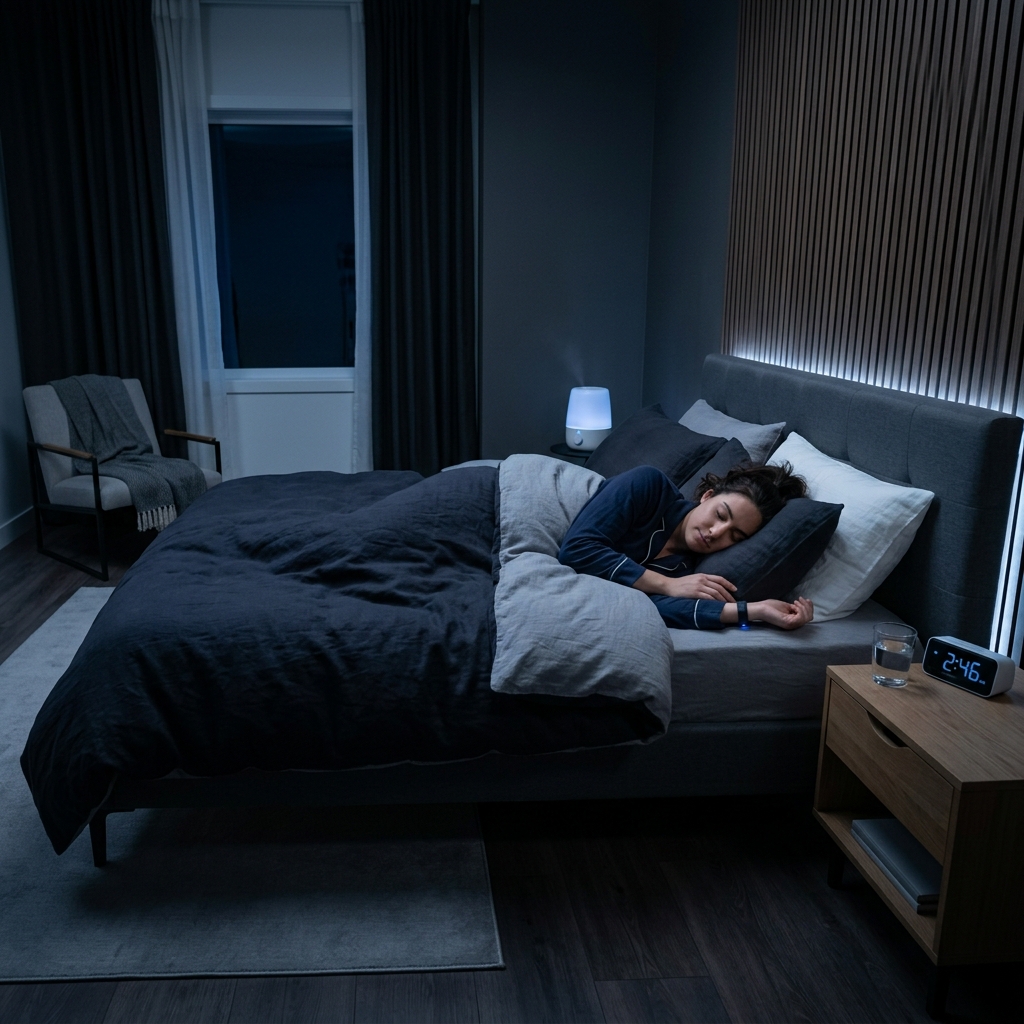
"Yes - sleep has a real, measurable effect on weight loss, and it works in two directions. Too little sleep makes you eat more (especially carb-heavy snacks), and - the part most people miss - when you diet on too little sleep, more of the weight you lose comes from muscle instead of fat."
The encouraging flip side is that getting more sleep has been shown to make people eat less without even trying. For most adults, aiming for 7–9 hours a night supports both halves of weight loss: eating less, and losing the right kind of weight.
Here's what the research actually shows - and, just as importantly, where it's less settled than the internet claims.
Short sleep is consistently linked to higher body weight
Across large population studies, people who habitually sleep less tend to weigh more. More than a third of adults regularly get less than the recommended amount of sleep, and short sleep (under about 7 hours) is repeatedly associated with a higher body mass index and a greater risk of obesity.
The important caveat: these are associations, not proof of cause. People who sleep poorly may differ in other ways too. That's exactly why the controlled experiments below matter - they test what actually happens when you change someone's sleep and hold other things steady.
Poor sleep makes you eat more - especially carbs
This is one of the most reliable findings in the field. When researchers cut healthy people's sleep and then let them eat freely, they eat more.
+328 kcal
Extra Calories/Day
+24%
Higher Hunger
In one controlled study, lean young men ate about 328 extra calories a day after sleep restriction - almost entirely from carbohydrate-rich snacks. In earlier work, sleep-restricted volunteers reported roughly 24% higher hunger and 23% higher appetite, with the biggest jump in desire for calorie- and carb-dense foods.
There's also a simpler factor on top of the biology: the longer you're awake, the more hours and opportunities you have to eat - particularly late at night.
The hormone story - real, but not as settled as you've heard
The popular explanation is that short sleep raises ghrelin (the "I'm hungry" hormone) and lowers leptin (the "I'm full" hormone). Some early, influential studies did find exactly that pattern.
But it's worth being honest here, because most articles aren't: a 2025 systematic review of six randomised trials found no consistent change in ghrelin or leptin after sleep loss. So the hormone mechanism is plausible and may well contribute, but it isn't the whole story. The bottom line that does hold up is behavioural: short sleep increases how much people eat. The exact hormonal cause is still being worked out.
The part most people miss: sleep changes what you lose
This is the single most important finding for anyone actively trying to lose weight.
In a 2010 University of Chicago study published in the Annals of Internal Medicine, 10 overweight adults dieted on the same number of calories through two separate two-week periods - once sleeping 8.5 hours a night, once sleeping just 5.5 hours. They lost the same total weight both times.
But the composition of that weight loss was dramatically different. On 5.5 hours of sleep, the proportion of weight lost as fat dropped by 55%, and the loss of lean (muscle) mass rose by 60%. In plain terms: short sleep made them lose more muscle and less fat - for the exact same diet. A later eight-week trial found the same pattern.
The takeaway is uncomfortable but useful: you can watch the scale go down while sleep-deprived and still be undermining your body composition, holding onto fat while shedding the muscle you're trying to keep.
The good news: more sleep, less eating - without trying
The flip side is genuinely encouraging, and it comes from a strong, recent trial.
In a 2022 randomised controlled study in JAMA Internal Medicine, 80 overweight adults who normally slept under 6.5 hours a night received a single sleep-hygiene counselling session. That alone helped them sleep about 1.2 hours more per night - and they went on to eat roughly 270 fewer calories per day than the control group, with no change in physical activity.
Sustained over time, a 270-calorie daily deficit adds up to meaningful weight loss. Over the two weeks, the sleep group lost a little weight while the control group gained a little. No new diet. No new workout. Just more sleep.
How much sleep, and what to actually do
Most adults need 7–9 hours. If you're trying to lose weight, the practical message is to treat sleep as part of the plan rather than an afterthought:
Keep consistent times
Keep consistent sleep and wake times, even on weekends.
Wind-down routine
Build a wind-down routine and cut off caffeine well before bed.
Optimize the bedroom
Keep the bedroom cool, dark, and screen-free.
Protect your sleep
Protect your time in bed the way you'd protect a workout or a meal-prep session.
Helpful Guides:
One more thing worth flagging: if you snore loudly, gasp or stop breathing in your sleep, or feel exhausted no matter how many hours you spend in bed, that's worth raising with a doctor. Untreated sleep apnoea is strongly tied to weight gain, and it needs proper diagnosis.
Frequently Asked Questions
References
- Taheri S, et al. Short Sleep Duration Is Associated with Reduced Leptin, Elevated Ghrelin, and Increased Body Mass Index. PLoS Medicine, 2004.
- Broussard JL, et al. Elevated ghrelin predicts food intake during experimental sleep restriction.
- Spiegel K, et al. Sleep curtailment in healthy young men is associated with decreased leptin, elevated ghrelin, and increased hunger and appetite. Annals of Internal Medicine, 2004.
- The Impact of Sleep Deprivation on Hunger-Related Hormones: A Meta-Analysis and Systematic Review. 2025.
- Nedeltcheva AV, et al. Insufficient Sleep Undermines Dietary Efforts to Reduce Adiposity. Annals of Internal Medicine, 2010.
- Tasali E, et al. Effect of Sleep Extension on Objectively Assessed Energy Intake Among Adults With Overweight in Real-life Settings: A Randomized Clinical Trial. JAMA Internal Medicine, 2022.