

When you stop eating added sugar, your body goes through a predictable sequence of changes - some uncomfortable in the first week, most profoundly positive from week two onward. Research shows that eliminating added sugar reduces visceral fat, stabilises energy levels, improves skin, lowers blood pressure, reduces inflammation, and significantly improves mood and cognitive function. The first 3–5 days are the hardest. After two weeks, most people report feeling dramatically better than they have in years.
Introduction: The Sugar Problem Nobody Fully Explains
The average adult in the United States consumes approximately 17 teaspoons (68 grams) of added sugar per day - more than double the American Heart Association's recommended maximum of 6 teaspoons for women and 9 for men. Much of this sugar is invisible - hidden in sauces, dressings, bread, yogurt, flavoured coffees, and so-called "healthy" foods.
The research on what excessive sugar consumption does to the body is unambiguous and alarming. A landmark 15-year study published in JAMA Internal Medicine (2014) found that adults consuming 25% or more of their daily calories from added sugar had a nearly threefold increased risk of dying from cardiovascular disease - independent of weight, physical activity, and other lifestyle factors.
But what happens when you stop?
This article covers the evidence-based timeline of what actually occurs in your body - hour by hour, day by day, week by week, and month by month - when you eliminate added sugar. The changes are more dramatic, faster, and more wide-ranging than most people expect.
Before the Timeline: What Counts as "Added Sugar"?
This article focuses on added sugar - not naturally occurring sugars in whole fruits, vegetables, or plain dairy. The distinction matters both physiologically and practically.
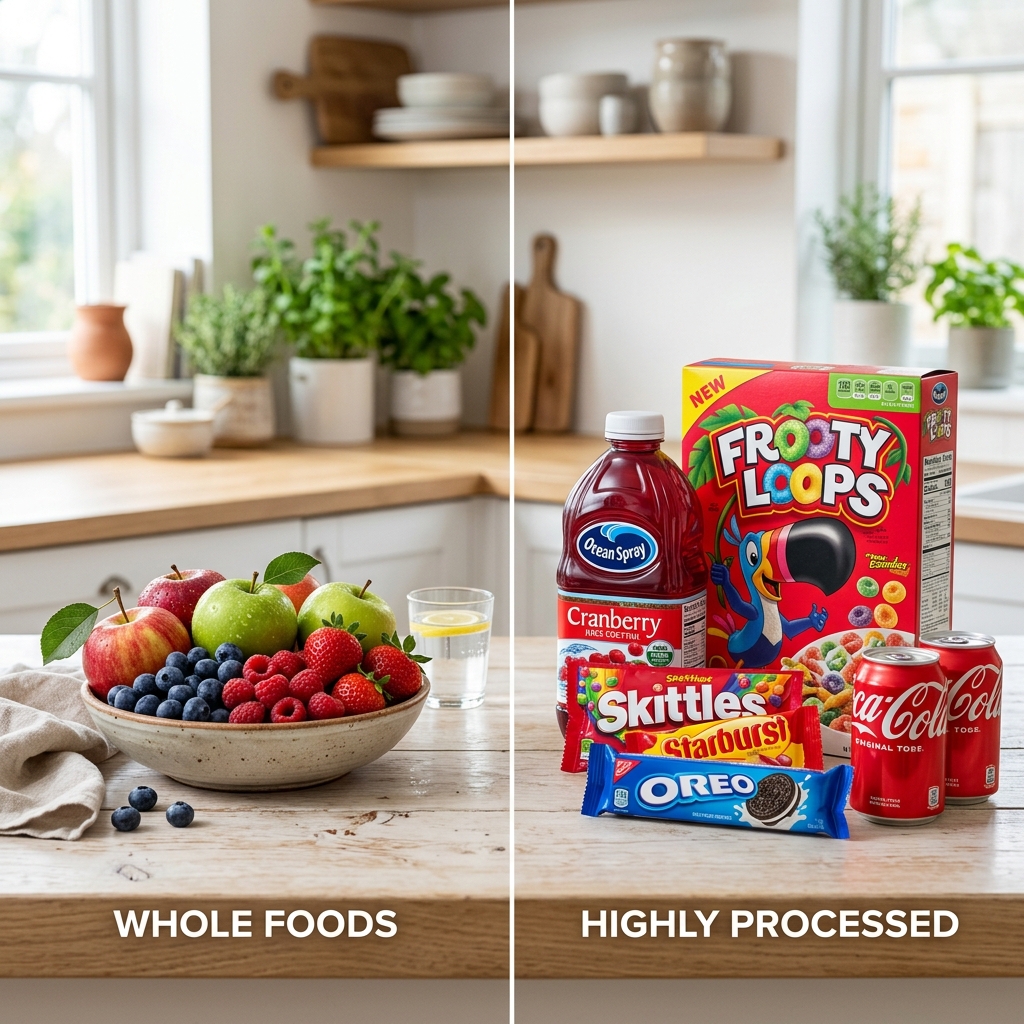
The body processes the sugar in a whole apple very differently than the sugar in apple juice, thanks to the fibre matrix.
Added sugars include:
- Table sugar (sucrose) added to food or drinks
- High-fructose corn syrup
- Honey, maple syrup, agave nectar
- Brown sugar, coconut sugar, raw sugar
- Fruit juice concentrates
- Dextrose, maltose, and other sugar derivatives
Natural sugars do NOT count:
- Sugar in a whole apple
- Lactose in plain yogurt or milk
- Fructose in whole berries
The research on sugar's harms focuses primarily on added sugars consumed without the fibre matrix of whole foods. Eating an apple is fundamentally different from drinking apple juice - the fibre in the whole fruit prevents the rapid glucose spike that drives the negative effects.
The Timeline: What Happens to Your Body
Hours 1–6: Your Blood Sugar Begins to Stabilise
Within hours of your last sugary meal or drink, your blood glucose begins a different pattern than usual. Instead of the sharp spike-and-crash cycle driven by refined sugar, glucose levels start to flatten.
Research using continuous glucose monitors - published in Nature Metabolism (2021) - found that post-meal glucose spikes and subsequent crashes are the primary driver of hunger, fatigue, and cravings throughout the day. Eliminating added sugar immediately begins to smooth this pattern.
What you might feel: Relatively normal, possibly some mild cravings if you typically consume sugar frequently.
Hours 6–24: The Cravings Begin
This is where things get interesting - and uncomfortable for many people.
Added sugar activates the brain's reward system through dopamine release in the nucleus accumbens. When sugar intake stops, dopamine release drops below baseline, producing cravings, irritability, headaches, fatigue, and difficulty concentrating.
Important context: The intensity of these symptoms is directly proportional to how much added sugar you were consuming.
Days 2–3: The Hardest Days
Days 2 and 3 are typically the most uncomfortable for people eliminating added sugar - and understanding why makes them significantly easier to push through.
- Blood sugar instability peaks: Swinging between mild hypoglycaemia and compensatory stress hormone release.
- Dopamine hits a low point: Manifests as low mood, decreased motivation, and a sense of flatness.
- Sleep may be disrupted: Overnight blood sugar fluctuations can cause brief awakenings.
What to do during days 2–3:
Eat enough food, ensure adequate protein/fat at meals, stay hydrated to prevent headaches, and eat whole fruit if cravings are intense.
Days 4–5: The Corner Turn
Most people who successfully navigate days 2–3 report a noticeable shift beginning around day 4 or 5. Energy flattens out predictably, cravings begin to reduce, taste perception begins to change (whole foods begin tasting sweeter), and digestive bloating improves rapidly as fructose fermentation drops.
Week 1 Complete: The Measurable Changes Begin
By the end of the first week, several physiological changes are measurable - not just felt.
- Scale weight drops 2–5 lbs: This is primarily water weight due to dropping insulin levels and sodium excretion.
- Energy levels become more consistent: The afternoon energy crash begins to disappear.
- Mood begins to improve: Reflecting stabilising dopamine and reduced blood sugar instability.
- Sleep improves: Reduced nighttime awakenings.
Week 2: The Transformation Accelerates
Week two is when most people become genuinely convinced that eliminating sugar was one of the best decisions they have made for their health.
- Genuine fat loss begins: A 2016 RCT published in Obesity found measurable visceral fat reduction beginning around the 10–14 day mark.
- Skin begins to clear: Reduced insulin and IGF-1 directly reduces sebum production and acne.
- Inflammation markers reduce: C-reactive protein (CRP) falls within 2 weeks.
- Cognitive function improves: Brain fog lifts as glucose variability reduces.
Week 3–4: The New Normal
By the third and fourth week, the body has largely adapted to operating without added sugar.
Taste perception is fully recalibrated. Foods that once seemed bland now taste genuinely sweet. Cravings are dramatically reduced or eliminated completely. Hunger becomes more stable and tied to genuine energy needs, and cardiovascular markers (like blood pressure) often show measurable reductions.
Month 2–3: The Long-Term Transformation
By months two and three of sugar elimination, the transformation is comprehensive. Visceral fat is significantly reduced. Insulin sensitivity is dramatically improved, the cholesterol profile improves (lower triglycerides, higher HDL), and energy levels are completely transformed into consistent, sustained energy without caffeine dependence.
🔗 Related: How to Get Rid of Belly Fat: Evidence-Based GuideWhat About Natural Sugars in Fruit?
One of the most common questions when eliminating added sugar is whether fruit should also be avoided. The research is clear: whole fruit is not the problem - and in fact it is part of the solution.
A 2013 meta-analysis in BMJ examining prospective studies found that consumption of whole fruit was associated with reduced risk of type 2 diabetes, while fruit juice consumption was associated with increased risk - despite similar total sugar content. The difference is the fibre matrix.
Whole fruit provides fructose packaged with fibre, water, polyphenols, and vitamins that dramatically slow absorption, prevent the sharp glucose spike, and provide additional anti-inflammatory and gut-health benefits.
Practical guidance: Whole fruit in normal amounts (2–3 servings per day) is not only permitted but encouraged during a sugar elimination programme. Fruit juice, even unsweetened, should be minimised.
Common Side Effects and How to Manage Them
Headaches (Days 1–4)
Cause: Blood sugar adjustment, caffeine withdrawal, dehydration.
Management: Increase water intake to 3+ litres, ensure adequate sodium, eat regular meals with protein and fat.
Fatigue and Low Energy (Days 1–5)
Cause: Dopamine system adjustment, blood sugar variability.
Management: Eat enough total calories. Prioritise protein and complex carbohydrates.
🔗 Related: Why Am I Always So Tired?Intense Cravings (Days 1–7)
Cause: Dopamine receptor undersimulation, blood sugar fluctuations.
Management: Have whole fruit available as a bridge. Eat protein immediately when cravings strike.
🔗 Related: How to Stop Feeling HungryThe Sugar Elimination Protocol: How to Do It Successfully
Research on behaviour change consistently shows that gradual reduction produces better long-term adherence than cold turkey elimination for most people - though both approaches work for different personality types.
Option 1: Cold Turkey
Eliminate all added sugar simultaneously. Expect days 2–3 to be uncomfortable. Research shows cold turkey approaches produce faster initial results and require less ongoing decision-making - but dropout rates are higher in the first week.
Best for: People with high motivation, those who find moderation harder than abstinence, and anyone with a specific deadline.
Option 2: Progressive Reduction
Gentler transition, more sustainable for long-term habits.
- Week 1: Eliminate all sugary drinks (sodas, juices, flavoured coffees).
- Week 2: Eliminate ultra-processed sweet snacks (biscuits, chocolate bars).
- Week 3: Eliminate added sugar in cooking and condiments.
- Week 4: Eliminate remaining hidden sugars in bread, sauces, flavoured yogurts.
Best for: People with high current sugar intake, those who find abrupt change difficult, and anyone who has previously failed at cold turkey approaches.
Frequently Asked Questions
The Bottom Line
The uncomfortable first 3–5 days are the body adapting to a fundamentally healthier metabolic environment. Every hour of discomfort in the first week is evidence that the sugar was having a real and measurable effect - and that its removal is producing real change.
The research is clear: eliminating added sugar is one of the highest-impact health interventions available. The changes it produces - in weight, energy, mood, skin, cardiovascular health, and cognitive function - are faster, more wide-ranging, and more profound than almost any other single dietary change.
Sources & References
- Yang Q et al. (2014). "Added sugar intake and cardiovascular diseases mortality." JAMA Internal Medicine.
- Avena NM et al. (2008). "Evidence for sugar addiction: behavioral and neurochemical effects." Neuroscience & Biobehavioral Reviews.
- Lustig RH et al. (2016). "Isocaloric fructose restriction and metabolic improvement." Obesity.
- Stanhope KL et al. (2009). "Consuming fructose-sweetened beverages increases visceral adiposity." Journal of Clinical Investigation.
- Smith DG et al. (2013). "Dopamine and sugar: neural basis of sugar reward." Current Biology.