
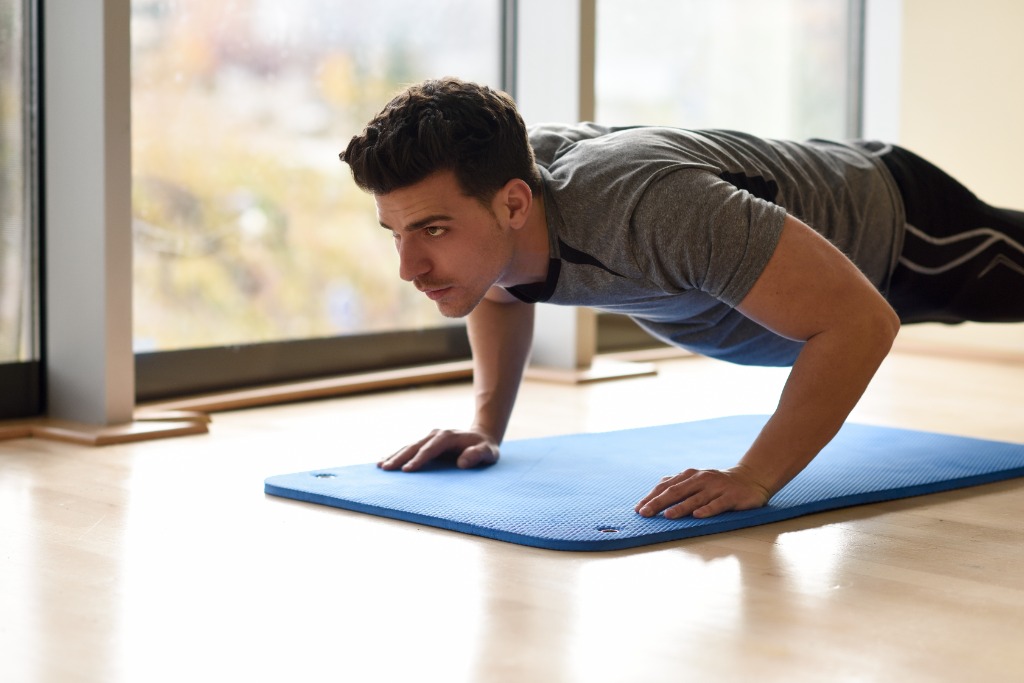
The plank is the most underrated exercise in fitness. Not because it's simple, but because most people do it wrong."Hold a plank for 60 seconds" is not a strategy. It's a starting point. This guide turns it into a system.
"Planks Are Just an Ab Exercise"
❌ The Claim
"If you want a six-pack, just do planks. They are isolated ab work."
✅ The Reality
It's a whole-body stability move. A 2014 study (J. Strength Cond. Res) found glute and shoulder activation levels often equal to rectus abdominis activation.
Source: Journal of Strength & Conditioning Research
The Plank Anatomy X-Ray
Your core is a cylinder, not just a "six-pack." To do a perfect plank, you need to pressurize the entire system.
Visual Diagram
The Core Cylinder: Diaphragm (Top), Pelvic Floor (Bottom), Multifidus (Back), Abs (Front)
The Ceiling & Floor
Diaphragm & Pelvic Floor. If you hold your breath, you lose the "ceiling" of stability. Breathing pressurizes the cylinder.
The Back Wall
Multifidus & Erector Spinae. These protect your spine. Weakness here is the #1 cause of chronic back pain.
Spinal Safety Stat
Source: Journal of Strength & Conditioning Research, 2014
The Progression Ladder
Don't skip steps. Earn your way up.
The Goal:
Start on hands and knees. Extend body straight. This reduces load by 40%, allowing deep stabilizers (Transversus Abdominis) to fire without being overwhelmed.
Visual Diagram
Mistake: The "Banana Back" (Lumbar Extension)
Readiness Test
Hold for 45 seconds.
Zero back sag. Controlled breathing.
The Goal:
Elbows under shoulders. Legs extended. This engages the full anterior and posterior chain. It's the gold standard for clinical core testing.
Readiness Test
Hold for 60 seconds.
Steady breath. No hip pike or sag.
The Goal:
Rotate to one arm. Lift hips. This trains the obliques and Glute Medius to resist rotation—key for preventing back injuries.
Visual Diagram
Target Area: Side Glute + Oblique (Where you should feel it)
Readiness Test
30 seconds per side.
Hips fully lifted. No wobbling.
The Goal:
From forearm plank, slowly lift one leg. This creates "Reactive Stability"—your core must adjust to a shifting center of gravity.
Visual Diagram
Form Check: Hips Stay Level While Leg Lifts (No Rotation)
Readiness Test
10 reps per side.
Zero hip rotation. Slow tempo.
The Goal:
Move from Front Plank → High Plank → Side Plank → Center → Side Plank. Full body integration under fatigue.
Readiness Test
3 Full Cycles.
Perfect form through all transitions.
"Longer Planks = Better Results"
❌ The Claim
"You should work up to holding a plank for 5 minutes. Use a stopwatch. Longer is always better."
✅ The Reality
Intensity beats duration. A 2019 study in Journal of Human Kinetics found that groups doing shorter, varied holds had 28% greater improvement in core stability stability than those doing long static holds (90s+).
Source: Journal of Human Kinetics, 2019
Build Your Routine
Foundation (Level 1-2)
For Beginners
| Exercise | Reps/Time | Rest |
|---|---|---|
| Knee Plank | 3 x 45s | 30s |
| Forearm Plank | 3 x 30s | 30s |
| Dead Bug | 3 x 8/side | 30s |
Stability (Level 3)
Intermediate
| Exercise | Reps/Time | Rest |
|---|---|---|
| Forearm Plank | 2 x 60s | 20s |
| Side Plank | 2 x 30s/side | 20s |
| Leg Lifts | 2 x 6/side | 30s |
Common Questions
Can planks replace crunches?
Yes. They are safer (less spine compression) and activate more muscles.
Is it safe daily?
Yes, broadly. But Level 4-5 are intense—rest 24-48hrs if you are going heavy.